
How to Play Dungeons & Dragons: A Quick, Engaging Guide
Date Posted:10 February 2026
Ever dreamt of being the hero in your own fantasy epic? That's exactly what Dungeons & Dragons is all about. It isn't a board game where one person wins; it's a shared storytelling adventure where you and your friends create the story together.
Your Adventure Begins: An Introduction To D&D
At its heart, Dungeons & Dragons (D&D) runs on pure imagination. One person takes on the role of the Dungeon Master (DM), who acts as the storyteller, referee, and the voice of every character you meet in the world. Everyone else gets to be a hero, creating their own Player Character (PC). Together, you'll set off on epic quests, outsmart cunning puzzles, and face down terrifying monsters.
The whole game unfolds through conversation. The DM might set the scene: "You stand before a moss-covered ruin, its entrance choked with vines. What do you do?" From there, it's up to you. Your choices, along with a bit of luck from your dice rolls, shape what happens next and push the story forward. It's this mix of rules and pure creative freedom that makes every game completely unique.
This is a great snapshot of what a game looks like in full swing—you've got the DM behind their screen, dice ready to roll, and players focused on their character sheets. It perfectly captures that shared focus and imagination as the story comes to life right there on the table.
Why D&D Is More Popular Than Ever
What used to be a niche hobby has absolutely boomed into a global sensation, and New Zealand is right in the thick of it. From packed gaming cafés in Auckland to cosy living rooms in Christchurch, Kiwis everywhere are rolling dice and telling stories.
So, what's the big deal? It’s the social, creative spark. D&D is a fantastic way to unplug from screens and really connect with your mates. You're not just playing a game; you're building a world and a history together, one session at a time. This collaborative spirit is what gives it such an enduring charm.
Dungeons & Dragons provides a unique framework for collaborative storytelling, allowing players to build friendships, solve complex problems, and explore fantastical worlds limited only by their collective imagination.
Here in New Zealand, the tabletop scene has seen a massive surge since the 5th edition of D&D was released. In fact, local game shops in Auckland, Wellington, and Christchurch reported a staggering 150% increase in sales of D&D gear between 2018 and 2023. It’s been amazing to see the Kiwi gaming community grow like this.
What This Guide Will Cover
Feeling keen but a bit lost on where to begin? No worries. This guide is here to cut through the confusion and show you exactly how to play. We'll break everything down into simple, practical advice for brand-new players.
Here’s a taste of what we’ll get into:
- The absolute must-haves you'll need for your first game night.
- A clear, step-by-step walkthrough for creating your very first character.
- A simple breakdown of the core rules in plain English.
- Handy tips on roleplaying and table etiquette so everyone has a blast.
By the end, our goal is to get you feeling confident enough to pull up a chair, roll some dice, and kick off your own legendary adventure.
Gearing Up For Your First Game Night
Alright, so you're ready to dive into ancient ruins and maybe even face down a dragon. Before you do, every adventurer needs to pack their bag. Getting equipped for your first Dungeons & Dragons session is easier and cheaper than you might think; it’s all about grabbing a few key items to make sure things run smoothly.
The great thing is, you can start playing with almost no investment. Plenty of resources are free online, but for many of us, the feel of physical dice and a paper character sheet is a huge part of the D&D experience. Let's break down what you absolutely need versus what's just nice to have.
The Absolute Must-Haves
To pull up a chair for your first game, you really only need a few things. Think of this as your adventurer's starting pack—everything required to bring your character to life and interact with the world your Dungeon Master has dreamed up.
- A Set of Polyhedral Dice: This is the heart and soul of D&D. A standard set has seven dice: a d4, d6, d8, d10, a percentile die (d00), a d12, and the king of them all, the 20-sided die (d20). That d20 is what you'll roll for almost every meaningful action, from swinging a sword at a goblin to sweet-talking a grumpy city guard.
- A Character Sheet: This is your hero's CV. It's where you'll track their stats, skills, equipment, and backstory. You can easily find the official sheets to download and print for free right from the Dungeons & Dragons website.
- A Pencil and an Eraser: Your character is a living, breathing person who is constantly changing. You'll gain new gear, lose hit points in a fight, and burn through spell slots, so a trusty erasable pencil is your best friend for keeping that sheet current.
And that’s it! Seriously. With just those three things, you are 100% ready to play D&D. Picking out your first set of dice is a bit of a rite of passage, and you'll find an incredible range of colours and styles at local Kiwi stores or online at places like Gamersphere NZ.
Helpful Extras to Level Up Your Experience
Once you have the basics sorted, a few other items can make the game feel more organised and immersive. None of these are essential for your first session, but they are popular additions that most players pick up as they fall deeper into the hobby.
The Player's Handbook is hands-down the most valuable book you can own. It contains all the rules you’ll need for creating characters, combat, spellcasting, and exploration. While someone at the table (usually the DM) will have one, having your own copy makes learning how to play Dungeons & Dragons a whole lot easier.
Owning a Player's Handbook is a game-changer. It lets you explore all your character’s options without having to constantly ask to borrow the group's copy. It's the key to unlocking your own creativity and truly mastering your role at the table.
Other fantastic, but non-essential, accessories include:
- A Dice Tray: A simple tray stops your dice from flying across the table and knocking over everyone's drinks or miniatures. It gives you a nice, contained surface for a fair roll every time.
- Miniatures: These small figures represent your character and the monsters on the battlefield. They aren't strictly necessary—people use everything from coins to bottle caps—but they add a brilliant visual element to combat.
- A Notebook: Perfect for jotting down the names of important people, places you've visited, quest details, or just that hilarious thing the party's bard said. You'll thank yourself later.
To make it even clearer, here’s a quick-reference table breaking down what you need to get started.
Essential Gear for Your First D&D Adventure
| Item | Essential or Optional? | Primary Use | Available at Gamersphere NZ? |
|---|---|---|---|
| Polyhedral Dice | Essential | Resolving actions like attacks and skill checks | Yes |
| Character Sheet | Essential | Tracking your hero's stats and abilities | Free online |
| Pencil & Eraser | Essential | Updating your character sheet during the game | N/A |
| Player's Handbook | Optional | Core rulebook for players | Yes |
| Dice Tray | Optional | Keeping dice rolls contained and organised | Yes |
| Miniatures | Optional | Visualising combat and exploration | Yes |
Ultimately, your local hobby shop or an online retailer like Gamersphere NZ can be a fantastic one-stop-shop for everything from starter sets to individual dice, making it incredibly easy to gear up for your grand adventure.
Bringing Your First Character To Life
Alright, you've got your gear. Now for the best part: creating your very own hero. This is where a blank character sheet transforms into a living, breathing adventurer, complete with a unique story, powerful abilities, and maybe a few funny quirks. It might look like a daunting page of boxes and numbers at first, but trust me, this is a fun, creative process that sets the stage for every epic moment to come.
Your character is how you see and interact with the game world. They're more than just stats on a page; they are your protagonist in a story you build with your friends. The choices you make here will shape how you solve puzzles, fight monsters, and connect with the other heroes at the table.
This flowchart gives you a bird's-eye view of the process, from the essentials to the final character sheet.
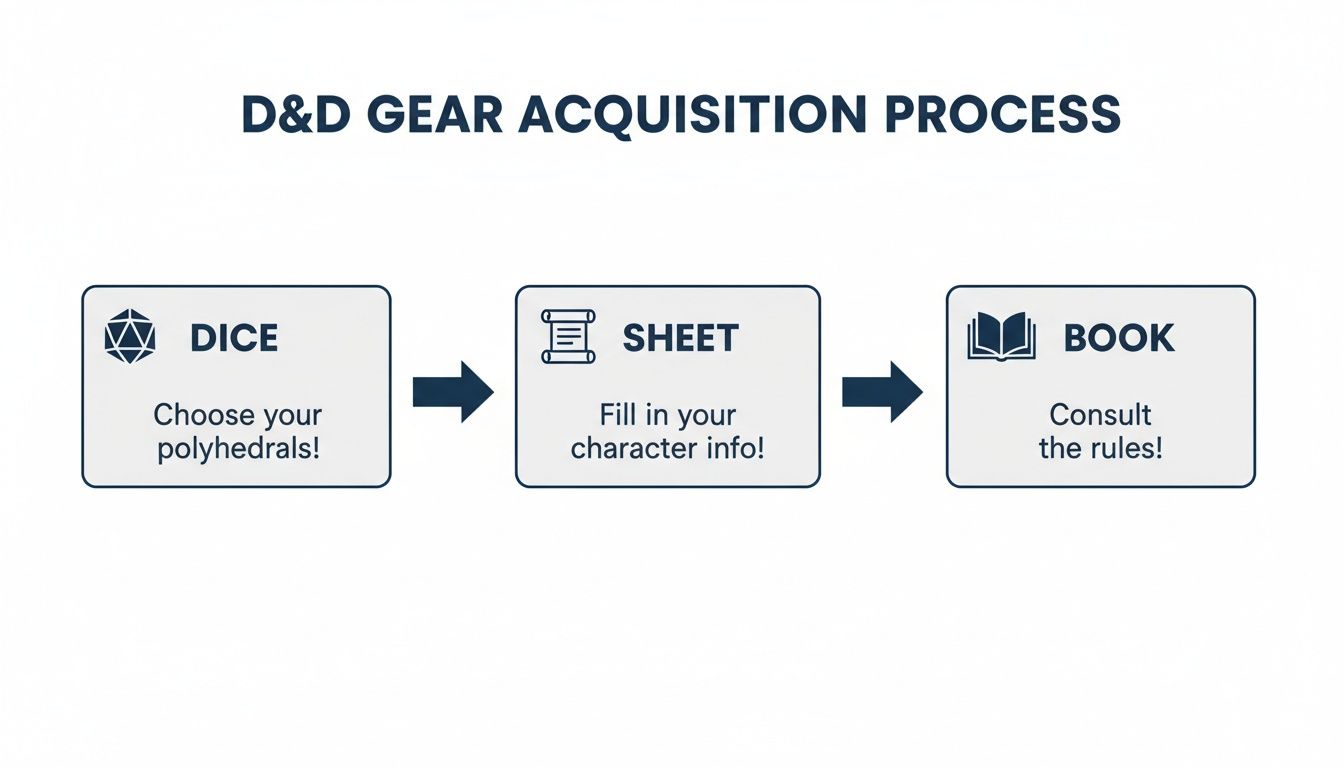
Essentially, you start with the basics (dice, character sheet) and then dive into the rulebooks where all your creative options live.
Choosing Your Race And Class
First things first, you need to decide on your character's Race and Class. These are the twin pillars of your hero's identity, influencing their natural talents, skills, and overall role in the party.
Race is your character's ancestry, and it comes with a bundle of innate abilities and traits. Are you a stoic, tough-as-nails Dwarf, most comfortable deep underground? Or maybe a graceful and perceptive Elf with a deep connection to the ancient forests? The Player's Handbook is full of classic fantasy options, each with its own flavour.
- Dwarf: Known for their incredible toughness (they get a Constitution bonus) and skill with axes and hammers.
- Elf: Agile and wise (hello, Dexterity bonus), often great at spotting hidden things and naturally resistant to magical charms.
- Halfling: Small, incredibly lucky, and stealthy. Perfect if you want to play a character who’d rather avoid trouble than start it.
- Human: The ultimate all-rounders. They're versatile and ambitious, with balanced ability scores that can fit any Class you can imagine.
Class, on the other hand, is your character's profession or calling. It dictates what you do—your combat style, your unique skills, and any special abilities you might have. This is arguably the most important choice you'll make, as it defines your job within the team.
- Fighter: A master of weapons and armour. They are brutally effective and can be built to handle just about any combat situation.
- Rogue: Cunning and agile, a Rogue excels at stealth, disabling traps, and striking from the shadows when enemies least expect it.
- Wizard: A book-smart magic-user who bends the arcane energies of the universe to their will through years of intense study.
- Cleric: The divine agent of a god, wielding holy magic to heal their friends and bring righteous fury down on their foes.
Think about the kind of hero you find exciting. Do you want to be on the front lines, shield held high, protecting your friends? Or would you rather hang back, supporting them with powerful spells? Combining a Race and Class is your first big step toward making that fantasy a reality.
Defining Your Ability Scores
Next up are the six core Ability Scores. These numbers are the engine of your character, representing their raw potential and forming the basis for almost every roll you'll make. They are Strength, Dexterity, Constitution, Intelligence, Wisdom, and Charisma.
A high Strength means you can swing a greatsword harder and carry more loot. High Dexterity helps you dodge fireballs and land a perfect arrow shot. A character with high Intelligence might decipher an ancient riddle, while one with high Charisma could persuade a grumpy city guard to look the other way.
Every ability score has a number (usually between 8 and 20 for a new character) and a corresponding modifier. This modifier is what you'll actually add to your d20 rolls. A score of 10 or 11 gives you a +0 modifier, while a mighty score of 18 or 19 gives you a sweet +4 bonus.
Your ability scores are the mechanical heart of your character. They translate your hero's concept—"I'm strong," "I'm smart," "I'm charming"—into tangible numbers that directly impact your success in the game.
Crafting A Background And Personality
So, who was your character before they started kicking down dungeon doors? That's where their Background comes in. A Background gives your hero a place in the world, a couple of extra skill proficiencies, and some fantastic hooks for roleplaying.
Were you a scholarly Sage who practically lived in a library? A street-smart Urchin who grew up fending for yourself? Or maybe a noble Knight sworn to an oath? This choice adds so much depth and helps you answer the crucial question: why is your character risking their life on adventures?
This is also the perfect time to flesh out your character's personality. The Player's Handbook has a great system for this, suggesting you jot down a few key traits:
- Personality Traits: A couple of quick descriptors (e.g., "Sarcastic," "Endlessly optimistic," "Always fidgeting").
- Ideals: What drives your character? (e.g., "Justice," "Freedom," "Knowledge").
- Bonds: A connection to a person, place, or event (e.g., "I'm searching for my long-lost mentor.").
- Flaws: A weakness or fear that makes your character feel real (e.g., "I'm terrified of deep water.").
These aren't meant to be rigid rules, but guideposts to help you make decisions and get into character at the table.
Putting It All Together: A Character Example
Let's do a quick walkthrough. I want to create a character who is quick on their feet and even quicker with their wits, preferring to talk or sneak their way out of trouble.
- Race & Class: A Wood Elf seems perfect for their natural agility (+2 Dexterity bonus) and keen senses. For Class, I’ll go with Rogue to really lean into that stealthy, skilled archetype.
- Ability Scores: I'll make Dexterity my highest score, no question. I'll follow that with Intelligence (for investigating clues) and Charisma (for fibbing my way past guards). Strength will be my dump stat; he’s not carrying anything heavy if he can help it.
- Background: The Charlatan background is a perfect fit. It gives me proficiency in Deception and Sleight of Hand, plus fun stuff like a disguise kit. My story is that I was a con artist who decided to use my skills for something better after a job went sideways.
- Final Touches: I'll pick my starting gear (a shortbow, a pair of daggers, leather armour) and fill out the rest of the sheet. And just like that, my character, "Faelan," is ready for his first adventure!
Character creation is a huge part of the fun. You'll combine a race and class, assign your ability scores using a method like the standard array or point buy (where you get 27 points to spend), and choose a background for flavour. For a deeper dive, it's always interesting to see what the wider D&D player community is creating. Once these choices are locked in, you're officially ready to play.
Understanding The Core Rules Of The Game
So, you’ve brought a hero to life on paper, and their character sheet is buzzing with potential. But how do you actually make all those numbers and notes do something? Learning to play Dungeons & Dragons is all about getting to grips with its core mechanic—a beautifully simple system that handles everything from clashing swords to tense negotiations.
When you get right down to it, almost every challenge you'll face in D&D is resolved with one simple process. You tell the Dungeon Master what you want your character to try, and they’ll likely ask you to make a check. This is the moment where your character's innate skill meets the roll of the dice.
The Core Mechanic: D20 + Modifier
The engine that drives the entire game is this: roll a 20-sided die (the d20), add a relevant number from your character sheet (a modifier), and see if you beat a target number. That’s the secret sauce. This single formula is what determines success or failure for pretty much every significant action your character takes.
That target number is called the Difficulty Class (DC). Your DM decides this on the fly, based on how tough the task is. Trying to kick in a flimsy, rotting door might only be a DC of 10, but trying to scale a sheer, icy cliff during a blizzard? That’s going to be a much tougher DC of 20 or even higher.
If your final number meets or beats the DC, you pull it off. If it’s lower, you fail. Simple as that.
How Ability Checks Work In Practice
Most of the time, you'll be using this core mechanic for ability checks. These cover any action that isn't a straightforward attack. The real magic is how the game links your six ability scores—Strength, Dexterity, Constitution, Intelligence, Wisdom, and Charisma—to whatever you're trying to accomplish.
Let's imagine a classic D&D situation. Your party needs to get past a grumpy-looking guard who's blocking the entrance to a fancy party. There are a few ways you could tackle this, and each one would call for a different ability check.
- Strength (Athletics): You could try to just shove past him or maybe even force the gate open yourself.
- Dexterity (Sleight of Hand): As your mate creates a distraction, you might try to deftly pluck the keys from his belt without him noticing.
- Charisma (Persuasion): You could try to spin a yarn, confidently telling him you’re on the guest list and your invitation must have gotten lost in the post.
For each attempt, you’d roll your d20 and add the modifier for that specific skill. If your Rogue has a juicy +5 bonus to their Persuasion skill, they've got a much better shot at talking their way past the guard. This is how your character's stats directly shape their odds of success.
The d20 roll brings the element of luck, while your character’s modifiers reflect their natural talent and training. It’s a perfect mix, ensuring even the most seasoned hero can have an off day, and the clumsiest warrior can sometimes achieve the impossible.
The Rhythm Of Combat
Sooner or later, the talking will stop, and the swords will come out. Combat in D&D might seem intimidating at first, but it follows a clear, turn-based structure to keep the chaos organised. You'll pick it up in no time.
Here's the basic flow of a combat round:
- Roll for Initiative: The moment a fight kicks off, everyone involved—players and monsters alike—rolls a d20 and adds their Initiative modifier (which is simply your Dexterity modifier). This one roll sets the turn order for the entire fight, from highest to lowest.
- Take Your Turn: When it's your turn in the order, you get to do stuff! You can typically take an Action, a Bonus Action, and use your Movement.
- Repeat: After everyone has had their turn, the round ends. A new one begins, following the same initiative order, until one side is left standing.
What You Can Do On Your Turn
Knowing what you can do on your turn is the key to being effective in a fight. It all breaks down into a few simple categories.
Your Action is your main event for the turn. This is typically when you'll swing your sword, fire an arrow, cast a powerful spell, or use a key class feature. You only get one Action, so make it count!
Movement is easy enough—you can move up to your character's speed (usually about 30 feet) anytime during your turn. You can even split it up: move a bit, take your action, and then move the rest of the way.
A Bonus Action is a smaller, quicker thing you can do. Not every character will have something to do with their bonus action every turn, but for some classes, like the dual-wielding Ranger or the cunning Rogue, it's a core part of their strategy.
Finally, you have a Reaction. This is a special, lightning-fast response you can make on someone else’s turn when a specific trigger occurs. The classic example is the "attack of opportunity"—if an enemy right next to you tries to run away, you get a free swipe at them as they go.
Once you’ve got your head around these core ideas, you’re ready to face almost anything the DM can dream up. The whole game is built on this foundation, making it easy to learn but deep enough for a lifetime of creative, heroic adventures.
Playing Your Role And Having Fun As A Group
Dungeons & Dragons really comes alive when you realise it's so much more than just rules and dice. It’s a shared storytelling adventure. Honestly, learning how to play D&D is just as much about learning to be part of a creative team. The most unforgettable moments aren't about landing a critical hit; they’re about players stepping into their characters' shoes and building a story together.

Getting into character, or roleplaying, doesn't mean you need to be a professional actor. You don’t have to put on a silly voice, either (though you absolutely can if you want to!). It’s all about making decisions from your character's point of view.
Just ask yourself: what would my hot-headed Dwarf fighter really do here? He probably wouldn't sit back and wait for a complex plan to unfold. He’d be the first one to suggest kicking the door down.
Embracing Your Character
Thinking like your character is a muscle you build over time. Start small. Remember those Personality Traits, Ideals, Bonds, and Flaws you wrote down? Think of them as your roleplaying cheat sheet.
If your character has a flaw like "I can't resist a shiny treasure," let that guide your actions. Maybe you recklessly pry open a trapped chest because the gleam of gold was just too tempting. These choices create interesting, often hilarious, complications that make the story richer for everyone at the table.
The goal of roleplaying isn't to 'win' D&D. It's to make choices that feel true to your character, even when they aren't the most "optimal" ones. Trust me, a heroic failure is often far more memorable than a simple success.
Essential Table Etiquette
Because D&D is a cooperative game, a bit of basic table etiquette goes a long way. It’s what ensures everyone has a fantastic time. The best adventuring parties are built on mutual respect and teamwork, both in and out of character.
Keep these simple guidelines in mind:
- Share the Spotlight: Every character deserves a moment to shine. Be conscious of letting others speak and take the lead, especially when the situation calls for their character's unique skills.
- Listen Actively: Pay attention when the DM is describing a scene or when another player is taking their turn. It keeps the game flowing and shows you respect what others are bringing to the table.
- Know Your Abilities: You don't need to memorise the entire rulebook, but having a basic handle on what your character can do helps keep combat zipping along at an exciting pace.
- Embrace Teamwork: Work with your party, not against them. D&D is designed for a group of heroes tackling challenges together. Scheming against your fellow players is a fast way to ruin the fun for the whole group.
The Power Of A Session Zero
One of the best ways to kick off a new campaign is with what we call a Session Zero. This is basically a pre-game meeting where the DM and players get together to create characters, chat about the tone of the game, and get on the same page.
During Session Zero, you can talk about what kind of story everyone wants to tell. Will it be a gritty political thriller or a light-hearted, classic dungeon crawl? It’s also the perfect time to establish boundaries and discuss any topics that should be avoided so everyone feels comfortable. This one session can prevent a lot of misunderstandings down the road and helps build a solid foundation for your adventure.
Got Questions About Your First D&D Game?
Jumping into a world as massive as Dungeons & Dragons can feel a little daunting. You’ve got your character sheet, you’ve maybe flicked through a rulebook, but a few things are probably still a bit hazy. That’s completely normal. Let’s clear up some of the most common questions we hear from new players right here in New Zealand so you can walk into your first session with confidence.
What’s the Deal with Different D&D Editions?
You’ll often hear veteran players talking about "3.5," "4e," or "5e." Think of these "editions" like major software updates for the game. Each one revises the rules, sometimes a little, sometimes a lot.
The one you need to know about is 5th Edition (5e).
Released back in 2014, 5e was a game-changer. It was designed from the ground up to be more intuitive and welcoming for newcomers while still having plenty of depth for experienced players. It puts the focus squarely on creative storytelling and fun. If you’re just starting your D&D journey today, 5e is absolutely the way to go. Almost every starter set, rulebook, and gaming group you'll find across NZ is running on this system, making it the easiest and most supported way to dive in.
How Do I Find a D&D Group in New Zealand?
This is the big one! Finding a crew of fellow adventurers is way easier than you might think. The Kiwi D&D community is super friendly and always keen to welcome new faces.
Here are the best places to look:
- Your Local Game Store: Heaps of hobby shops around the country host regular D&D nights. They are the perfect low-pressure environment to learn the ropes and meet other players in your area.
- Online Kiwi Communities: Jump onto Facebook or Discord and search for New Zealand D&D groups. You'll find bustling hubs where people are constantly organising games, both online and in-person.
- Virtual Tabletops: If you want to play from home, sites like Roll20 and Fantasy Grounds have dedicated forums to find online games, connecting you with players from all over NZ and even internationally.
Seriously, don't be shy about posting that you're a new player looking for a group. Plenty of us love showing newcomers the ropes!
What Does a Dungeon Master Actually Do?
The Dungeon Master (DM) is the heart of the game. They're the storyteller, the referee, and the director all rolled into one. While the other players each control a single hero, the DM runs the entire world around them.
The DM's job is to:
- Describe the world, from the smell of a dank dungeon to the chaos of a city marketplace.
- Act out all the Non-Player Characters (NPCs) the heroes meet—the grumpy blacksmith, the mysterious wizard, the scheming villain.
- Control the monsters and lay out the challenges the party will face.
- Make the final call on rules to keep the game flowing smoothly.
It sounds like a big responsibility, and it is, but it's also one of the most creative and rewarding ways to play. D&D Starter Sets are brilliant for first-time DMs, giving them a pre-written adventure and all the guidance they need to get started.
Being the DM is like being the architect of a shared dream. You set the stage, but the players' choices write the story. It's a unique and fulfilling way to experience the game.
How Much Does It Really Cost to Get Started?
Great news on this front: you can start playing D&D for free. The basic rules are available as a free download from the official Dungeons & Dragons website, and there are plenty of free dice-rolling apps for your phone. You don't need to spend a cent to see if you like it.
If you decide you want the full tactile experience, the barrier to entry is still very low. A starter set is easily the best bang-for-your-buck. These boxes bundle a simplified rulebook, a set of dice, pre-made characters, and a whole adventure for a really decent price.
After that, your first big purchase will likely be the Player's Handbook. From there, you can build your collection of books and accessories over time, meaning you can tailor the cost to fit your budget.
Ready to start your adventure? Gamersphere NZ has everything you need, from starter sets and rulebooks to dice and miniatures. Find your perfect adventuring gear and get ready to roll for initiative.
Prepared with the Outrank app